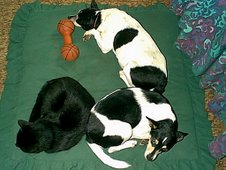
- Make each of the socialization events as pleasant and non-threatening for the puppy as possible. If a puppy's first experience with any new experience is an unpleasant one, it will be very difficult to undo that in the puppy's mind. In some cases, an early trauma can morph into a phobia that can last for a lifetime. It is better to take things slow and avoid having the puppy become frightened or injured.
- Try inviting your friends over to meet the new puppy. It is important to included as many different people as possible in the puppy's circle of acquaintances, including men, women, children, adults, as well as people of many diverse ethnic backgrounds and ages.
- Also invite friendly and healthy dogs and puppies over to meet your puppy. It is important for the puppy to meet a wide variety of other animals, including cats, hamsters, rabbits and other animals he is likely to meet. It is of course important to make sure that all animals the puppy comes into contact with have received all necessary vaccinations.
- Take the puppy to many different places, including shopping centers, pet stores, parks, school playgrounds and on walks around the neighborhood. Try to expose the puppy to places where there will be crowds of people and lots of diverse activity going on.
- Take the puppy for frequent short rides in the car. During these rides, be sure to stop the car once in a while and let the puppy look out the window at the world outside.
- Introduce your puppy to a variety of items that may be unfamiliar. The puppy should be exposed to common items like bags, boxes, vacuum cleaners, umbrellas, hats, etc. that may be frightening to him. Allow and encourage the puppy to explore these items and see that he has nothing to fear from them.
- Get the puppy used to a variety of objects by rearranging familiar ones. Simply placing a chair upside down, or placing a table on its side, creates an object that your puppy will perceive as totally new.
- Get the puppy used to common procedures like being brushed, bathed, having the nails clipped, teeth cleaned, ears cleaned, etc. Your groomer and your veterinarian with thank you for this.
- Introduce the puppy to common things around the house, such as stairs. Also introduce the puppy to the collar and leash, so he will be comfortable with these items.
There are of course some things to avoid when socializing a puppy. These socialization don'ts include: - Do not place the puppy on the ground when strange animals are present. An attack, or even a surprise inspection, by an unknown animal could traumatize the puppy and hurt his socialization.
- Do not inadvertently reward fear based behavior. When the puppy shows fear, it is normal to try to sooth it, but this could reinforce the fear based behavior and make it worse. Since biting is often a fear based behavior, reinforcing fear can create problems with biting.
- Do not force or rush the socialization process. It is important to allow the puppy to socialize at his own pace.
- Do not try to do too much too soon. Young puppies have short attention spans, and continuing lessons after that attention span has passed will be a waste of your time and your puppy's.
- Do not wait too long to begin. There is a short window in which to begin the socialization process. A young puppy is a blank slate, and it is important to fill that slate with positive socialization skills as early as possible.
Training your new puppy - eliminating bad habits
Anyone who owns a dog or puppy will eventually run into the need to eliminate unwanted habits. While most dogs are eager to please their owners and smart enough to do what is asked of them, it is important for the owner to properly communicate just what constitutes acceptable and unacceptable behaviors.
Each type of unacceptable behavior requires its own specific cures, and in most cases the cures will need to be tailored to fit the specific personality of the dog. Every breed of dog has its own unique personality characteristics, and every individual within that breed has his or her own unique personality.
Whining, howling and excessive barking
Let's start with one of the most frequently encountered problem behaviors in both dogs and puppies. While some barking and other vocalizing is perfectly normal, in many cases barking, howling and whining can become problematic. This is particularly important for those living in apartment buildings, or in closely spaced homes. Fielding complaints about barking is not the best way for you and your dog to meet the neighbors.
Some tips of dealing with excessive whining, barking and howling include: - If your puppy or dog is howling or whining while confined to its crate, immediately take it to its toilet area. Most puppies and dogs will whine when they need to do their business.
- It is important to teach a dog or a puppy to accept being alone. Many dogs suffer from separation anxiety, and these stressed dogs can exhibit all sorts of destructive and annoying behaviors. It is important to accustom the puppy to being left on its own, even when the owner is at home.
- Always strive to make the puppy or dog as comfortable as possible. Always attend to the physical and psychological needs of the dog by providing food, water and toys.
- If the dog is whining, check for obvious reasons first. Is the water dish empty? Is the dog showing signs of illness? Has his or her favorite toy rolled under the furniture? Is the temperature of the room too hot or too cold?
- Do not reward the puppy or dog for whining. If the dog whines when left alone, for instance, it would be a mistake to go to the dog every time it whines.
After you have ensured that the dog's physical needs are being met, and that discomfort is not responsible for the whining, do not hesitate to reprimand the dog for inappropriate behavior.
Problem Chewing
Puppies naturally chew, and they tend to explore their world using their mouths and teeth. While chewing may be normal, however, it is not acceptable, and it is important to nip any chewing problems in the bud to prevent the chewing puppy from growing into a chewing dog.
Providing a variety of chew toys is important when teaching a puppy what is appropriate to chew and what is not. Providing a variety of attractive chew toys is a good way to keep the puppy entertained and to keep his teeth and gums exercised. Scented or flavored toys are great choices for most puppies.
The puppy should be encouraged to play with these chosen toys, and the puppy should be effusively praised every time he or she plays with or chews these toys.
Another great strategy is to encourage the puppy to get a toy every time he or she greets you. Every time the puppy greets you or a member of your family, teach him to get one of his toys.
It is also important to exercise good housekeeping techniques when training a puppy not to chew on inappropriate items. Keeping the area to which the puppy has access free and clean is important. Keeping items out of reach of the puppy will go a long way toward discouraging inappropriate chewing. Try to keep the puppy's area free of shoes, trash, and other items, and always make sure that the area has been properly puppy proofed.
If the puppy does pick up an inappropriate item like a shoe, distract the puppy and quickly replace the item with one of its toys. After the puppy has taken the toy, praise it for playing with and chewing that toy.
Try booby trapping items the dog should avoid by spraying them with bitter apple, Tabasco sauce or other nasty but non-toxic items.
Training your puppy - start by winning his respect and confidence
The basis of training any animal is winning its trust, confidence and respect. True training cannot begin until the animal has accepted you as its leader, respects you and entrusted you with his or her confidence.
The mistake many puppy owners make is mistaking love and affection for respect and confidence. While it is certainly important to love your new puppy, it is also very important that the puppy respect you and see you as his leader. Dogs are naturally pack animals, and every dog looks to the lead dog for advice and direction. Making yourself the pack leader is vital to the success of training any dog.
Failure to gain the respect of the dog can create a dog who is disobedient, out of control and even dangerous. Problem dogs are dangerous, whether they are created through bad breeding, owner ignorance or improper training. It is important to train the dog right from the start, since retraining a problem dog is much more difficult than training a puppy right the first time.
It is important for any new dog owner, whether working with a 12 week old puppy or a twelve year old dog, to immediately get the respect of the animal. That does not mean using rough or dangerous handling methods, but it does mean letting the dog know that you are in control of the situation. Dogs need structure in their lives, and they will not resent the owner taking control. As a matter of fact, the dog will appreciate your taking the role of trainer and coach as you begin your training session.
When working with the dog, it is important to keep the training sessions short at first. This is particularly important when working with a young puppy, since puppies tend to have much shorter attention spans than older dogs. Keeping the training sessions short, and fun, is essential for proper training.
Beginning training sessions should focus on the most basic commands. The heel command is one of the most basic, and one of the easiest to teach. Start by putting the dog or puppy in a properly fitted training collar. Be sure to follow the instructions for fitting and sizing the color to ensure that it works as intended.
Begin to walk and allow your dog to walk beside you. If the dog begins to pull, gently pull on the leash. This in turn will tighten the training collar and correct the dog. If the gentle pressure is ineffective, it may be necessary to slowly increase the pressure. Always be careful to not over-correct the dog. Using too much pressure could frighten the dog and cause it to strain more. If the opposite problem occurs and the dog lags behind, the owner should gently encourage it until it is walking beside the owner.
Most dogs figure out the heeling concept fairly rapidly, and quickly figure out that they should walk beside their owners, neither lagging behind nor pulling ahead. Once the dog has mastered heeling at a moderate pace, the owner should slow his or her pace and allow the dog to adjust along with it. The owner should also speed up the pace and allow the dog to speed up as well. Finally, walking along and changing pace often will reinforce the lesson that the dog should always walk at the heel of the handler.
From heeling, the next step should be to halt on command. This halt command works well as an adjunct to heel. As you are walking, stop and watch your dog. Many dogs immediately realize that they are expected to stop when their handler does. Others may need the reminder of the leash and the training collar.
After the halt on command has been mastered, the handler should encourage the dog to sit on command as well. Once the dog has stopped, the handler gently pushes on the dog's hindquarters to encourage the sit. Usually, after this walk, halt, sit procedure has been done a few times, the dog will begin to sit on his own each time he stops. Of course, it is important to provide great praise, and perhaps even a treat, every time the dog does as he is expected.
Tips for house training your new puppy
House training a puppy is one of the first, and one of the most important things, that any new dog owner must do. It is easy to get frustrated if you do not understand the basics of this important process, so I have put together a few tips to make the process of house training your puppy a little easier.
It is vital to establish good toilet and hygiene habits in the puppy when he is young, since the patterns that are established in those first few months can last a lifetime.
When you consider that house training issues are the number one reason why dogs are surrendered to animal shelters, it is easy to see why house training is so extremely important.
In most cases, a puppy will not be completely house trained until he or she is six months of age. That is because puppies younger than six months often lack the bowel and bladder control that they need in order to be reliably left alone in the home all day.
Puppies younger than six months should be confined to a small, puppy proofed room when the owner cannot supervise them. The entire floor of the room should be covered with newspapers or similar absorbent materials, and the paper changed every time it is soiled. As the puppy gets older, the amount of paper used can be reduced as the puppy begins to establish a preferred toilet area. It is this preferred toilet area that will form the basis of later house training.
- The Do's of House Training Your Puppy:
- Always provide the puppy with constant, unrestricted access to the established toilet area.
- When you are at home, take the puppy to the toilet area every 45 minutes.
- When you are not at home or cannot supervise the puppy, you must be sure the puppy cannot make a mistake. This means confining the puppy to a small area that has been thoroughly puppy proofed. Puppy proofing a room is very similar to baby proofing a room, since puppies chew on everything.
- Always provide a toilet area that does not resemble anything in your home. Training the puppy to eliminate on concrete, blacktop, grass or dirt is a good idea. The puppy should never be encouraged to eliminate on anything that resembles the hardwood flooring, tile or carpet he may encounter in a home.
- Praise and reward your puppy every time he eliminates in the established toilet area. The puppy must learn to associate toileting in the established areas with good things, like treats, toys and praise from his owner.
- Always keep a set schedule when feeding your puppy, and provide constant access to fresh, clean drinking water. A consistent feeding schedule equals a consistent toilet schedule.
- Using a crate can be a big help in helping a puppy develop self control. The concept behind crate training is that the puppy will not want to toilet in his bed area.
- And finally, it is important to be patient when house training a puppy. House training can take as long as several months, but it is much easier to house train right the first time than to retrain a problem dog.
The Don'ts of House Training Your Puppy - Never reprimand or punish the puppy for mistakes. Punishing the puppy will only cause fear and confusion.
- Do not leave food out for the puppy all night long. Keep to a set feeding schedule in order to make the dog's toilet schedule as consistent as possible.
Do not give the puppy the run of the house until he has been thoroughly house trained.
House training is not always the easiest thing to do, and some dogs tend to be much easier to house train than others. It is important, however to be patient, consistent and loving as you train your dog. A rushed, frightened or intimidated dog will not be able to learn the important lessons of house training. Once you have gained your puppy's love and respect, however, you will find that house training your puppy is easier than you ever expected.
Eliminating problem behaviors when training your puppy
Unfortunately, eliminating problem behaviors is one thing that most dog owners eventually face. This article will focus on a few of the most commonly encountered behavior problems.
Problem #1 - Jumping up on people
One of the most frequently cited problems with dogs is that of jumping up on people. Unfortunately, this is one of those behaviors that is often inadvertently encouraged by well meaning owners. After all, it is cute and adorable when that little 10 pound puppy jumps up on you, your family members and your friends. Many people reward this behavior on the part of a small puppy with kisses and treats.
This is a huge mistake, however, since that cute little puppy may soon become a full grown dog who could weigh well in excess of 100 pounds. Suddenly that cute jumping behavior is no longer quite so cute.
In addition to being annoying, jumping up on people can be dangerous as well. A large, heavy dog, jumping enthusiastically, can easily knock over a child or an older or handicapped adult. In today's litigious society, such an incident could easily make you, as the dog's owner, the subject of an unwanted lawsuit.
The time to teach a dog that jumping up on people is unacceptable is when he is still young and easy to handle. Retraining a dog that has been allowed to jump up on people can be difficult for the owner, and confusing for the dog.
When the puppy tries to jump on you or another member of your family, gently but firmly place the puppy's feet back on the floor. After the puppy is standing firmly on the floor, be sure to reward and praise him.
It is important for every member of the family, as well as frequently visiting friends, to understand this rule and follow it religiously. If one member of the family reprimands the dog for jumping and another praises him, the dog will be understandably confused. As with other dog training issues, consistency is the key to teaching the dog that jumping is always inappropriate.
When praising and rewarding the dog for staying down, it is important for the trainer to get down on the dog's level. Giving affection and praise at eye level with the puppy is a great way to reinforce the lesson.
Problem #2 - Pulling and tugging at the leash
Pulling on the leash is another problem trait that many puppies pick up. Unfortunately, this behavior is also one that is sometimes encouraged by well meaning owners. Playing games like tug of war with the leash, or even with a rope (that can look like the leash to the dog) can unwittingly encourage a problem behavior.
The use of a quality body harness can be a big help when training a puppy not to pull, or retraining a dog that has picked up the habit of pulling on the leash. Try training the puppy to accept the body harness the same way it accepts the regular buckle collar.
When walking with your dog, try using a lure or toy to encourage the dog to remain at your side. A training collar, when properly used, can also be a good training tool for a problem dog. When using a training collar or choke chain, however, it is very important to fit it correctly, and to use a size that is neither too big nor too small for your dog.
When walking with your puppy, it is important to keep the leash loose at all times. If the puppy begins to pull ahead, the handler should quickly change directions so that the puppy fast finds itself falling behind. It is important to reverse directions before the puppy has reached the end of the leash. The leash should stay loose except for the split second it takes the handler to reverse direction. It is important to use a quick tug, followed by an immediate slackening of the leash.
When training a puppy, it is important to never let the puppy pull you around. Training the puppy to walk properly while he or she is still small enough to handle is absolutely vital, especially when dealing with a large breed of dog. If your 150 pound Great Dane hasn't learned to walk properly while he or she is still a 20 pound puppy, chances are it never will.
It is important not to yank or pull on the puppy's neck when correcting him. A gentle, steady pressure will work much better than a hard yank. The best strategy is to use the least amount of pressure possible to achieve the desired result.
I will continue with training your puppy in the next post.